The Essential Seasonal Home Maintenance Checklist to Prevent Mid-Summer AC Breakdowns
Surviving the Shift: When Spring Pollen Meets Peak Summer Heat
Before the July heat peaks, homeowners need a reliable seasonal home maintenance checklist to ensure their property is ready for the extreme weather ahead. The transition from spring to summer in Eastern North Carolina is beautiful, but it brings a severe, often hidden challenge for your home cooling system. At Daniels Heating & Air Conditioning, our team typically sees the aftermath of this transition firsthand. As the heavy pine pollen season ends, it leaves behind a thick yellow residue on everything outside. Almost immediately, local weather patterns shift, delivering 90-degree temperatures mixed with oppressive humidity.
This rapid shift from dry pollen drop to high humidity creates a worst-case scenario for air conditioners. The environmental stress forces a critical decision point for homeowners: relying on a basic DIY filter swap or recognizing the need for a deep, professional outdoor coil cleaning. Ignoring this transition usually leads to an overworked compressor and a sudden mid-summer system failure right when you need cooling the most.
To keep your system running efficiently, we highly recommend scheduling professional Air Conditioning Services before the worst of the heat arrives.
The Hidden Threat: How Yellow Pine Pollen Suffocates Your Condenser
Generic national maintenance guides often completely ignore the localized environmental factors of Goldsboro and Wayne County. Our technicians know exactly how aggressive the yellow pine pollen can be during April and May, because we spend all summer cleaning it out of local HVAC units. What most homeowners do not realize is exactly how this natural phenomenon mechanically impacts their outdoor AC unit.
Your air conditioner cools your home by absorbing indoor heat and releasing it outside through the aluminum fins of the condenser coil. For this heat transfer to work, the coil needs unrestricted airflow and clean metal surfaces.
The Bake-On Effect:
• Spring accumulation: The outdoor unit's fan draws in massive amounts of air, pulling heavy yellow pine pollen directly into the delicate fins of the condenser coil.
• Summer humidity: As the spring-to-summer transition occurs, early summer humidity introduces moisture to the dry pollen dust.
• The thermal blanket: This moisture turns the pollen into a sticky paste. As the AC runs and the coil heats up, this paste bakes onto the aluminum, forming a hardened, insulating blanket.
Once this insulating layer forms, the refrigerant inside the coils cannot effectively release heat into the outside air. Because the heat remains trapped, your compressor is forced to run longer cycles at much higher operating pressures. This severe restriction in heat transfer is the primary catalyst for mid-summer system strain. If this specific regional buildup is ignored, the compressor will eventually overheat, leading to a costly breakdown during the hottest weeks of the year.
Indoor Maintenance: Optimizing Airflow and Quality
While the outdoor unit faces harsh environmental elements, the indoor components of your cooling system require just as much attention. Proper indoor maintenance reduces the overall workload on your air conditioner, helping it overcome the stress of high summer temperatures. A thorough approach goes beyond just looking at the equipment itself; it involves managing how air moves through your entire home.
Focus on these core indoor tasks to optimize your system's performance before the heat sets in:
• Inspect all return and supply vents: Walk through every room and ensure that heavy furniture, rugs, or curtains are not blocking your air registers. Blocked vents increase static pressure inside the ductwork, forcing the blower motor to work much harder to distribute air.
• Check thermostat settings: Verify that your thermostat is programmed for your summer schedule. Upgrading to a smart thermostat can help reduce cooling loads while you are away at work.
• Monitor indoor humidity: Your AC does two jobs: it lowers the temperature and removes moisture. If your home feels cool but clammy, the system may be short-cycling or struggling to dehumidify properly.
• Evaluate distribution: Consider how evenly your home cools. If certain rooms are always hot, you might benefit from exploring Advanced Air Distribution & Zoning Systems to direct cooling exactly where it is needed without overworking the main unit.
Filter Replacement Protocol
The single most important indoor DIY task is managing your air filter. During the spring-to-summer transition, a standard 30-day filter may become completely saturated in just 15 days due to the heavy influx of pollen and allergens.
Choosing the right filter: A pattern we see often on our summer service calls is homeowners assuming that a higher MERV (Minimum Efficiency Reporting Value) rating is always better. However, ultra-dense filters designed to catch microscopic particles can actually restrict airflow so severely that they mimic the symptoms of a blocked duct or a failing blower motor. We recommend sticking to a MERV 8 to MERV 11 filter for an optimal balance of allergen capture and healthy airflow, and checking it every two weeks during peak pollen season.
Outdoor Unit Survival: Clearing the Two-Foot Perimeter
Maintaining the area around your outdoor condenser is a safe, highly effective DIY task that directly impacts system efficiency. The outdoor unit needs to pull in a massive volume of air to operate correctly. Any physical obstructions force the fan motor to work harder and reduce the amount of air available for the heat transfer process.
Follow these specific steps to establish a healthy environment for your outdoor equipment:
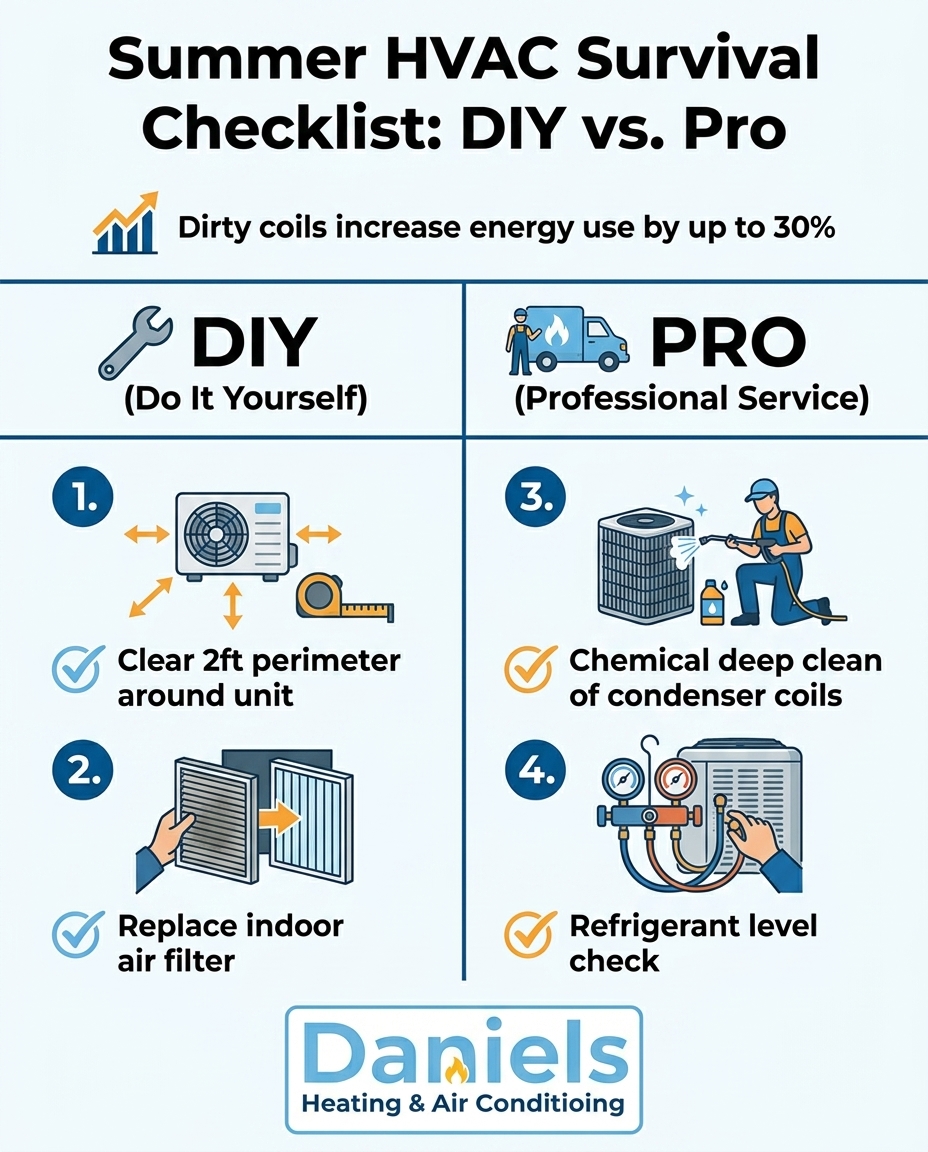
1. Establish a clear two-foot perimeter: Measure a two-foot radius all the way around the outdoor HVAC unit. This entire zone must remain completely free of obstructions to allow for proper air intake.
2. Trim back summer foliage: Cut back any bushes, shrubs, or encroaching ornamental grasses that have grown near the unit during the spring. Plants create microclimates that trap humidity and heat right next to the condenser.
3. Remove loose debris: Carefully brush away loose leaves, pine needles, and grass clippings from the exterior casing. Never use a hard rake or shovel near the unit, as you could easily dent the metal casing or damage the wiring.
4. Visually inspect the coils: Shine a flashlight through the outer grilles and look at the aluminum fins. If you see the telltale yellow tint of baked-on pollen or a thick mat of dirt, you know the system is already suffocating.
Staying on top of these perimeter checks is a great first step, but it is best paired with a comprehensive Preventative Maintenance Plan to ensure the internal components are just as healthy as the exterior setup.
The True Cost of Dirty Coils on Summer Energy Bills
Skipping coil maintenance is not just a mechanical risk; it is a direct drain on your household budget. When pollen and grime form an insulating barrier on your outdoor unit, the financial impact begins immediately, long before the system actually breaks down.
The efficiency drain: According to data from the U.S. Department of Energy, operating an air conditioner with dirty condenser coils can increase the system's energy consumption by up to 30%. Because the system cannot release heat effectively, it has to run much longer to lower the temperature inside your home by even a single degree.
The math of neglect: If your system normally runs for 15 minutes to cool your living room, a pollen-clogged system might run for 25 minutes to achieve the exact same result. During peak summer in Eastern North Carolina, when the AC is already running frequently to combat the 90-degree heat, those extra minutes compound rapidly. This reduced efficiency translates directly to noticeably higher monthly utility bills.
Long-term wear and tear: Beyond the immediate spike in your electricity bill, running longer, hotter cycles causes severe wear on the compressor—the most expensive component in your entire HVAC system. Framing preventative maintenance as a proactive investment makes sense because the cost of a tune-up easily pays for itself through restored energy efficiency and the prevention of catastrophic compressor failure.
DIY vs. Professional Care: Knowing When to Call an Expert
A successful seasonal preparation strategy requires knowing exactly where your DIY capabilities end and where a licensed professional's expertise must begin. Attempting to perform advanced maintenance without the proper tools or training often causes extensive permanent damage to the equipment.
• Replacing indoor air filters — Who Should Do It: Homeowner (DIY) — Why It Matters: Prevents dust buildup on the indoor evaporator coil and ensures proper airflow through the ductwork.
• Clearing the 2-foot perimeter — Who Should Do It: Homeowner (DIY) — Why It Matters: Stops foliage and debris from physically blocking the air intake on the outdoor unit.
• Washing the condenser fins — Who Should Do It: Professional — Why It Matters: Using a DIY high-pressure washer will instantly bend and flatten the delicate aluminum fins, permanently ruining airflow.
• Deep chemical coil cleaning — Who Should Do It: Professional — Why It Matters: Requires specific, localized chemical solvents to safely dissolve baked-on Wayne County pine pollen without corroding the metal.
• Testing electrical & refrigerant — Who Should Do It: Professional — Why It Matters: Ensures capacitors are strong and refrigerant levels meet exact manufacturer specifications for peak cooling.
When it is time for the heavy lifting, you need a team that understands the specific environmental stressors of the region. After years of serving Eastern North Carolina, the team at Daniels Heating & Air Conditioning knows exactly how to handle the unique spring-to-summer transition that plagues Goldsboro systems. A professional tune-up goes far beyond wiping down the outside of the box; it involves testing the electrical draw of the compressor, verifying the refrigerant charge, and applying the correct foaming cleaners to safely push out hardened grime from the inside of the coil outward. If you suspect your system is struggling, scheduling a proper AC Inspection in Dunn or Goldsboro is the safest way to restore performance.
Beyond the HVAC: Complete Summer Home Prep
While your air conditioner is the most vital component for summer comfort, it does not operate in a vacuum. The overall condition of your home's envelope directly impacts how hard your cooling system has to work. To fully prepare your property for the season, you must address the exterior and interior barriers that keep the conditioned air inside and the harsh elements outside.
Incorporate these crucial tasks into your broader home preparation strategy:
• Inspect window and door weatherstripping: Summer heat is accompanied by heavy humidity. If the weatherstripping around your exterior doors or windows is cracked or peeling, latent heat and moisture will continuously seep into your home. This forces your AC to run longer simply to dehumidify the incoming air.
• Clean gutters and downspouts: The spring-to-summer transition often brings sudden, violent afternoon thunderstorms. Gutters clogged with spring debris and pine needles will overflow, potentially pushing water into your roofing fascia or pooling around your home's foundation.
• Test smoke detectors: Summer is a prime time for electrical storms and increased appliance usage. Test all smoke and carbon monoxide detectors, replacing the batteries to ensure your family's safety.
• Examine roof and siding: Spring winds and hail can cause minor damage that goes unnoticed until a heavy summer rainstorm hits. Do a visual sweep of your roofline to look for missing shingles or damaged siding panels.
Frequently Asked Questions About Summer Home and AC Maintenance
What should be on a home maintenance checklist for summer?
A comprehensive list should prioritize your home's cooling efficiency and exterior defense against summer storms. Start by replacing your indoor HVAC filter, clearing a two-foot perimeter around your outdoor AC unit, and checking window weatherstripping to keep humidity out. Additionally, you should clean your gutters to handle heavy summer downpours and test all smoke detector batteries for safety.
How do I prepare my AC for extreme summer heat?
The most effective preparation is ensuring the system has unrestricted airflow both indoors and outdoors. Swap out any air filters that are clogged with spring pollen, open all indoor air vents, and trim back any bushes growing near the outdoor condenser. Finally, schedule a professional seasonal tune-up to verify refrigerant levels and electrical connections before the system is under maximum load.
What happens to my system if the AC coils are dirty?
Dirty coils act like a thick thermal blanket, trapping heat inside the system instead of releasing it into the outdoor air. This restriction forces the compressor to run at much higher pressures and temperatures, causing the system to run longer cycles. Over time, this increases your energy consumption by up to 30% and dramatically raises the risk of a total compressor failure.
Can I clean my AC condenser coils myself?
You can safely brush away loose leaves and debris from the outside casing, but deep cleaning the coils should be left to a professional. At Daniels Heating & Air Conditioning, we often see the costly damage caused when well-meaning homeowners make the mistake of using high-pressure washers, which easily bend the delicate aluminum fins and ruin the unit's airflow. A professional technician uses specific chemical foaming agents to safely dissolve baked-on pollen from the inside out.
How often should I change my HVAC filter during pollen season?
During heavy pollen drops, you should inspect your filter every 15 days, as it can become saturated much faster than in the winter months. While standard advice suggests a 30-to-90-day replacement schedule, the heavy yellow pine pollen in Eastern North Carolina can clog a filter rapidly. A severely clogged filter will restrict airflow, causing the indoor coil to freeze over and shutting down the entire system.
Secure Your Home's Comfort Before the July Heat Peaks
Taking control of your seasonal home maintenance checklist is the best way to protect your property and ensure a comfortable living environment all summer long. By understanding how the shift from spring pollen to summer humidity impacts your equipment, you can take proactive steps to keep your energy bills low and avoid the stress of a mid-summer breakdown. The peace of mind that comes from a fully prepped home is invaluable when the temperatures climb into the 90s.
Do not wait until your system is actively struggling to keep up with the heat. Schedule your professional coil cleaning and comprehensive system inspection today by reaching out for expert HVAC Services in Dunn, NC, and the surrounding areas.
hear what our satisfied
clients have to say


Service areas