
Defining Home Comfort Repair: When to Address Inconsistent Room Temperatures
Why Is One Room Always Hotter Than the Rest?
Are you constantly adjusting the thermostat to cool an upstairs bedroom, only to freeze the downstairs living area? You set the dial to 72°F, yet the master suite feels like a sauna while the living room feels like an icebox. This exact frustration drives homeowners to search for home comfort repair to figure out what is actually going wrong. This situation forces a critical decision: do you have a broken air conditioner part, or does your home suffer from a fundamental airflow imbalance?
Solving these persistent hot and cold spots requires moving beyond basic troubleshooting. It starts with a foundation of comprehensive HVAC services to ensure the equipment is functioning, and then shifts toward holistic indoor air quality and comfort solutions to address how that conditioned air actually moves through your living spaces.
The thermostat on your wall is simply a sensor. It only measures the temperature in the exact hallway or room where it is installed. Once that specific area reaches the target temperature, the system shuts off—completely oblivious to the fact that the rooms at the far end of the house are still uncomfortably warm. Understanding why this happens is the first step toward reclaiming your home's comfort.
Home Comfort Repair vs. Mechanical HVAC Fixes
Home comfort repair is a comprehensive HVAC diagnostic approach focused on resolving systemic airflow, humidity, and ductwork issues that cause inconsistent room temperatures, rather than simply fixing broken mechanical components.
To understand the difference, consider a standard mechanical breakdown. For example, when a local homeowner's unit failed entirely during a spring warm-up, they needed urgent air conditioning repair and maintenance. A technician arrived the same day, identified a failed fan motor, and had the correct part on the truck. The system was repaired and blowing cold air again within hours. That is a mechanical fix—restoring the system's ability to generate cold air.
However, if your system runs continuously and produces cold air at the main vents, but specific zones remain stubbornly warm, you do not need a new fan motor. You need a systemic evaluation to ensure that the cold air actually reaches every room evenly. This is where comfort repair steps in.
Recognizing a Mechanical Failure
• Sudden loss of cooling: The system blows warm air or no air at all.
• Unusual noises: Grinding, squealing, or loud banging sounds coming from the outdoor compressor or indoor air handler.
• Power issues: The system repeatedly trips the circuit breaker or refuses to turn on entirely.
• Resolution: Often resolved the same day by replacing a specific failing component, such as a capacitor, contactor, or blower motor.
Recognizing a Comfort System Failure
• Uneven distribution: The AC runs continuously and produces cold air, but specific zones (like an upstairs office or a sunroom) remain uncomfortably warm.
• Short cycling with hot spots: The system turns on and off rapidly because the thermostat area cools down too quickly, leaving the rest of the house warm.
• High humidity pockets: Certain rooms feel sticky and clammy, even when the air conditioner is running.
• Resolution: Requires systemic evaluation of ductwork, static pressure, and air balancing rather than a single part replacement.
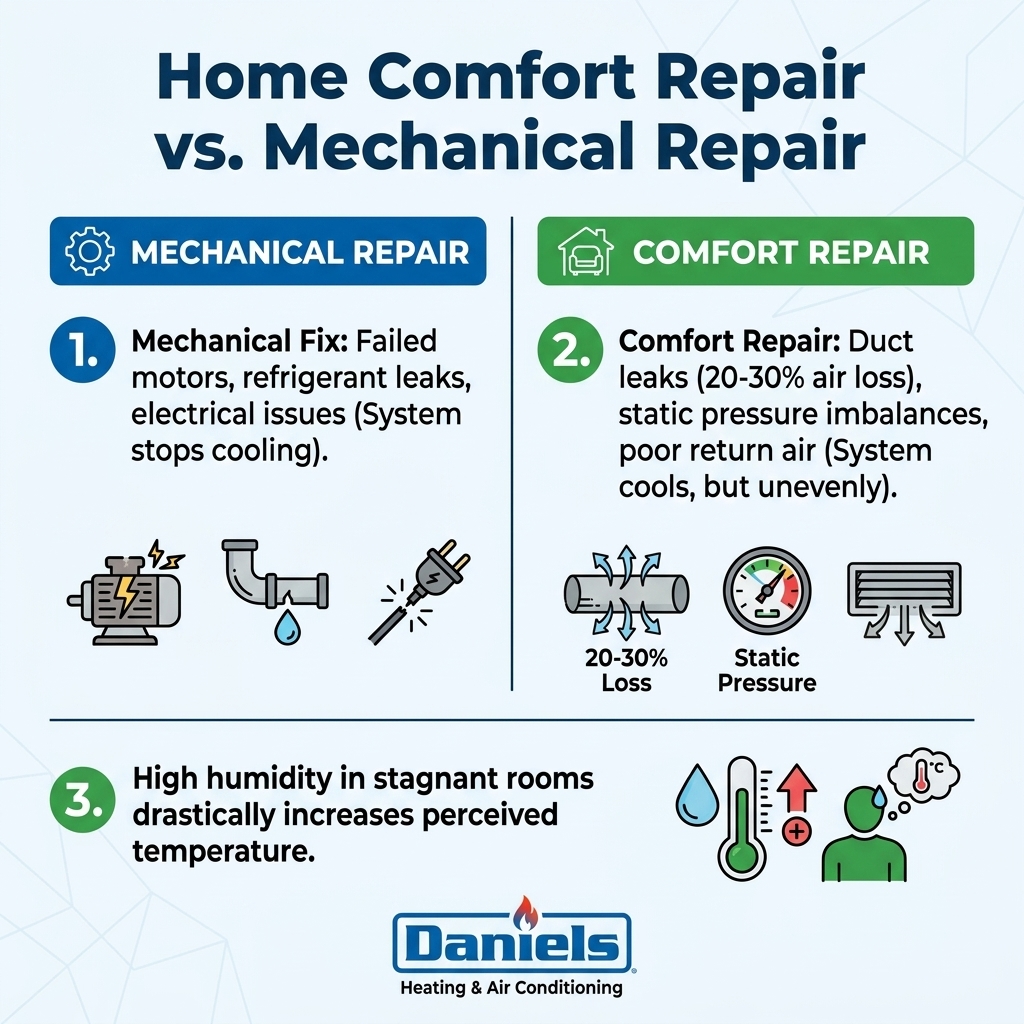
• Mechanical Fix — Primary Symptom: System stops cooling entirely — Typical Cause: Failed motor, blown capacitor, or refrigerant leak — Required Solution: Component replacement or refrigerant charge
• Comfort Repair — Primary Symptom: System cools, but unevenly — Typical Cause: Duct leaks, poor static pressure, restricted return air — Required Solution: Airflow balancing, duct sealing, or zoning
How Hidden Duct Leaks Sabotage Even Cooling
When you have persistent hot spots, the problem rarely lies with the air conditioner itself. Instead, the issue is usually hidden in the attic or crawlspace inside your ductwork. To understand this, you have to look at the mechanics of airflow distribution and a concept called static pressure.
Static pressure is the resistance to airflow in your heating and cooling system. Think of your ductwork like a plumbing system; if there is a massive leak in the main water line, the faucet at the very end of the house will only get a tiny trickle of water. Airflow works exactly the same way.
1. The Blower Generates Pressure: The indoor air handler pushes a specific volume of conditioned air into the main supply trunk.
2. Air Escapes Through Leaks: According to data from the Department of Energy, typical duct systems lose 20 to 30 percent of conditioned air to leaks, holes, and poorly connected joints.
3. Pressure Drops Significantly: As air bleeds out into the unconditioned attic, the static pressure inside the duct drops.
4. Distant Rooms Suffer: Because of this pressure loss, the rooms furthest from the blower receive only a fraction of the necessary cooling capacity.
The myth of closing vents: A common reaction to uneven cooling is to walk around the house and close the supply registers in unused rooms, hoping to force more air into the hot spaces. This is a mistake. Closing vents increases the static pressure inside the ductwork, which actually forces more conditioned air out through the hidden leaks. It also strains the blower motor, potentially turning an airflow problem into a costly mechanical failure.
The Impact of High Humidity on Perceived Room Temperature
Temperature is only half of the comfort equation; the other half is moisture. During humid North Carolina summers, the air is heavy with moisture. Your air conditioner is designed to act as a massive dehumidifier, pulling warm, wet air from the house, stripping the moisture out through condensation, and sending dry, cool air back in.
When a room suffers from poor airflow, the air in that space becomes stagnant. Stagnant air traps humidity. Because high indoor humidity reduces the human body's ability to cool itself through the evaporation of sweat, a poorly ventilated room will feel significantly warmer than the actual temperature reading on a thermometer.
During the milder days of spring, minor airflow restrictions might go entirely unnoticed. However, peak July heat exposes these underlying ductwork restrictions. The system runs near maximum capacity, and the disparity between the well-cooled hallways and the isolated, humid bedrooms becomes glaringly obvious. Proper home comfort repair in Goldsboro NC must address this moisture removal process. If the conditioned air cannot reach a room to absorb the heat, the humid air in that room cannot be cycled back to the unit for dehumidification. The result is a room that feels sticky, stuffy, and deeply uncomfortable.
Whole-Home Diagnostics: Moving Beyond the Thermostat
Many homeowners attempt to solve uneven temperatures by installing a newer, more advanced smart thermostat. While smart thermostats offer excellent scheduling features, they cannot defy physics. Upgrading the sensor on your wall will not push cold air through crushed ductwork or seal hidden leaks in the attic.
This is where Daniels Heating & Air Conditioning's comprehensive, whole-home approach to diagnostics makes a critical difference. True comfort requires going beyond simple mechanical fixes to evaluate the entire building envelope and HVAC delivery system.
A professional whole-home diagnostic process includes several vital steps:
• Measuring airflow at the registers: Technicians use specialized tools like anemometers or capture hoods to measure the exact cubic feet per minute (CFM) of air entering the hot rooms.
• Checking static pressure: By measuring the pressure on both the supply and return sides of the system, technicians can pinpoint whether the ductwork is too restrictive or suffering from severe leaks.
• Evaluating return air pathways: Supply air is only half the battle. If a room has no way to send warm air back to the unit, the incoming cold air will be choked off.
• Inspecting duct integrity: Physically inspecting the duct runs for kinks, disconnected joints, or degraded insulation that allows heat transfer.
If you are tired of battling the thermostat, reaching out to Goldsboro home comfort experts for this level of systemic evaluation is the only way to uncover the true root cause of your home's hot spots.
Advanced Solutions for Balancing Airflow
Once a comprehensive diagnostic is complete, a professional can implement targeted solutions to balance the airflow and restore even temperatures throughout the house. These solutions range from simple adjustments to advanced system upgrades.
Manual Dampening and Professional Airflow Balancing
Dampers are metal valves installed inside the main branches of your ductwork—not the grilles on your ceiling. A professional can adjust these dampers to restrict airflow to the over-cooled areas of the home, naturally redirecting more conditioned air to the distant, warmer rooms. This process, known as airflow balancing, ensures that the system's output matches the thermal load of each specific area.
Adding Dedicated Return Air Pathways
A major cause of hot bedrooms is a lack of return air. When you close a bedroom door, you effectively seal off that room from the home's central return grille. Pressure builds up inside the room, preventing new cold air from entering. Installing dedicated return air grilles in isolated rooms, or adding transfer grilles above the doors, alleviates this pressure imbalance and allows air to circulate freely.
Implementing Zoning Systems
For multi-level homes with distinct thermal needs—such as a second floor that bakes in the afternoon sun while the basement stays freezing—zoning is the ultimate solution. A zoning system uses motorized dampers inside the ductwork, controlled by multiple thermostats placed throughout the house. This allows the system to direct cooling capacity exactly where it is needed, exactly when it is needed. Homeowners looking to permanently eliminate multi-level temperature disparities should explore advanced air distribution and zoning systems.
Frequently Asked Questions About Home Comfort Repair
What is home comfort repair?
Home comfort repair is a holistic diagnostic service that fixes uneven temperatures, poor airflow, and high indoor humidity. Instead of replacing broken mechanical parts, it focuses on ductwork evaluation and airflow balancing to ensure every room receives proper cooling.
Why is my upstairs so hot when the AC is running?
Heat naturally rises, and upstairs rooms are often furthest from the blower motor. If your ductwork has leaks or poor static pressure, the cooled air simply cannot reach the second floor with enough velocity before warming up.
How do you fix inconsistent room temperatures?
Fixing inconsistent temperatures requires professional airflow balancing, sealing duct leaks, or adding return air vents. In severe cases, installing a dedicated zoning system allows you to control the temperature of different areas independently.
Is my AC broken if some rooms are warm?
Not necessarily. If cold air is blowing from vents near the indoor unit but not reaching distant rooms, your AC is likely functioning correctly. The issue usually lies in poor air distribution, blocked ducts, or inadequate return air pathways.
What is an HVAC zoning system?
An HVAC zoning system uses motorized dampers inside your ductwork connected to multiple thermostats. This setup directs conditioned air only to the zones that need it, eliminating hot and cold spots across different levels of your home.
Can high humidity make a room feel hotter than the thermostat says?
Yes. High indoor humidity prevents your body from cooling itself effectively through evaporation, making a room feel sticky and warm even if the thermostat reads 72 degrees. Proper airflow is essential to circulate that air back to the AC for dehumidification.
Schedule a Comprehensive Comfort Evaluation
True comfort is about consistent, even cooling and proper humidity control across every square foot of your living space. Stop guessing with thermostat adjustments and closing vents in hopes of pushing air upstairs. Get a professional airflow evaluation to properly diagnose your home's unique airflow dynamics. Speak with a local expert about your specific hot and cold spots to finally achieve the balanced, reliable comfort your home needs.
hear what our satisfied
clients have to say


Service areas