
The Post-Summer AC Assessment: Identifying Undiagnosed Compressor Strain Before Winter
The Hidden Cost of Surviving a Goldsboro Summer
Your cooling system has been running nonstop for months, but the house still feels comfortable, which makes it easy to assume everything is fine. The reality of The Post-Summer AC Assessment: Identifying Undiagnosed Compressor Strain Before Winter is that surviving intense heat often leaves deep, hidden wear on your equipment. When your air conditioner simply coasts into the cooler months without a thorough check, you risk locking in silent mechanical damage that will only worsen while the system sits idle.
Homeowners often face a critical choice right now: evaluate the system's health today, or shut it down blindly and risk a total failure upon restart next spring. The September early fall transition provides the ideal window for catching hidden wear and tear before it becomes permanent. By addressing these underlying issues now, you protect your investment and ensure your home remains comfortable year-round. If you need professional support with your air conditioning services, scheduling an AC inspection in Goldsboro is the most effective way to catch compressor strain before it turns into a costly emergency.
Why Late Summer is the Danger Zone for AC Compressors
The changing of the seasons does not instantly erase the mechanical toll taken by months of extreme weather. In our region, Goldsboro's hot and humid summers stretch well into early fall, maximizing compressor strain right before the transition season. Prolonged heat forces cooling systems to operate near their maximum capacity for weeks on end. This continuous operation drastically increases mechanical wear on moving parts and places immense stress on electrical components.
In our years serving the Goldsboro area, our technicians at Daniels Heating And Air Conditioning frequently see late-summer systems showing signs of severe fatigue that are completely invisible to the homeowner. A unit might still be pushing out cold air, but internally, it is working twice as hard to achieve the same result. Understanding why this happens requires a closer look at the specific climate challenges your system battles every day.
The Impact of Prolonged Humidity on System Load
Cooling a home involves two distinct processes: sensible cooling (lowering the temperature) and latent cooling (removing moisture from the air). In a humid subtropical climate, latent cooling demands a massive amount of energy. Your air conditioner must extract gallons of water from the indoor air just to make the environment feel comfortable.
This constant moisture removal keeps the compressor engaged for extended, grueling cycles. Instead of running for ten minutes and shutting off, the system might run for forty-five minutes straight just to manage the humidity. These extended cycles prevent the compressor motor from cooling down properly between runs, leading to cumulative thermal stress that peaks just as summer comes to a close.
The Myth of "If It Runs, It's Fine"
One of the most dangerous misconceptions about home HVAC systems is the belief that producing cold air equals mechanical health. A system can still blow cold air while operating under severe mechanical distress. For example, a failing fan motor might still turn, but it forces the compressor to work harder to reject heat outside.
Ignoring minor changes in system behavior is a risky gamble. Key warning signs often include:
• Subtle noise changes: A buzzing or humming sound that wasn't there in June.
• Extended run times: The system takes much longer to reach the target temperature on the thermostat.
• Hard starting: The lights in your home dim slightly when the AC kicks on, indicating a massive pull of electricity.
• Warmer air at the vents: The air is cool, but not as crisp as it was earlier in the season.
The Silent Killer: Decoding Abnormal Amp Draw
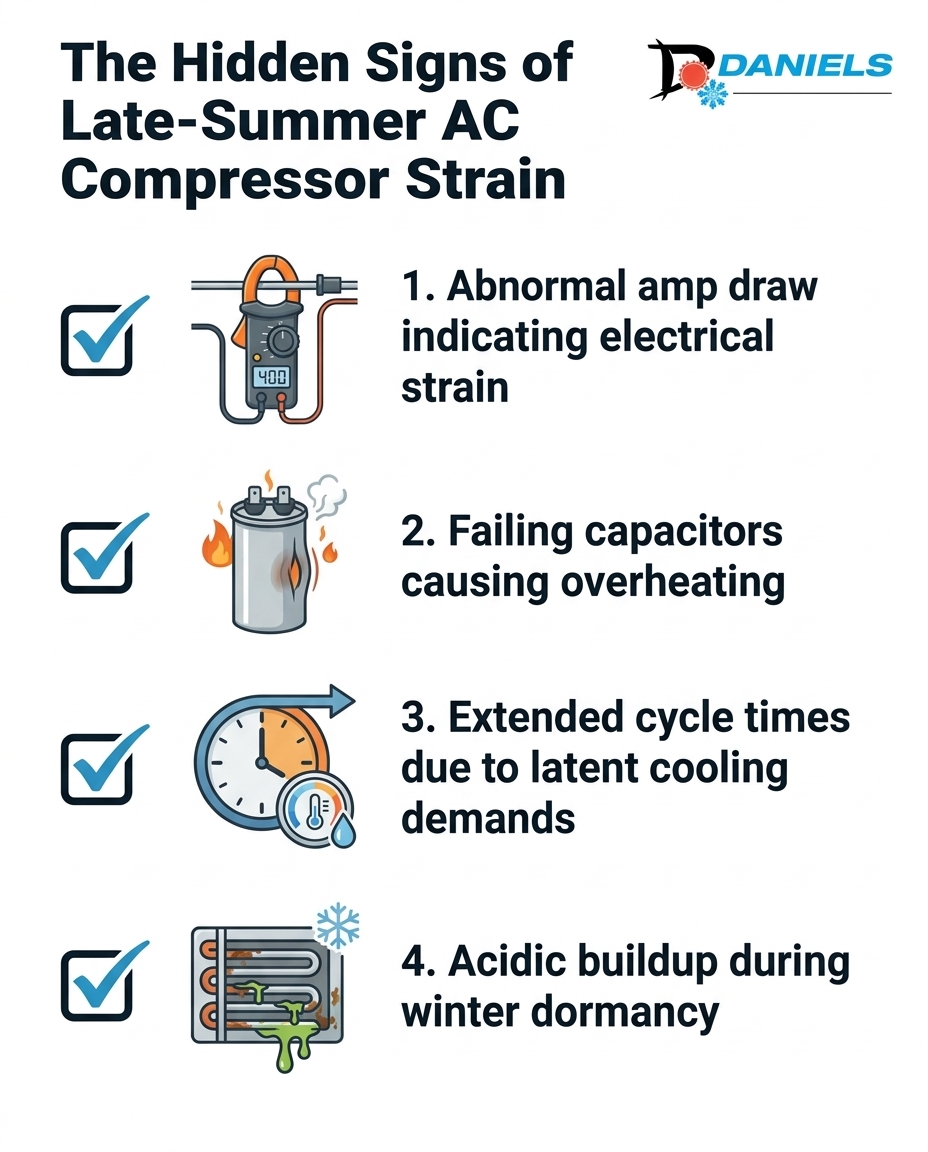
To truly understand compressor strain, professionals look beyond the thermostat and examine the electrical heartbeat of the system. Amp draw is a measurement of the electrical effort required by the compressor to start and continue running. When a system is healthy, it pulls a predictable, steady amount of electricity. When it is struggling, that electrical demand spikes, creating a condition known as abnormal amp draw on the compressor.
Testing for abnormal amp draw requires specialized tools and training, and it is strictly a job for licensed professionals due to the high-voltage risks involved. However, understanding what this metric tells us is crucial for recognizing the value of a late-summer assessment.
What Amp Draw Tells Us About Compressor Health
Think of your compressor like a vehicle driving up a steep hill. If the car is in the right gear and running well, it climbs smoothly. If it is towing a heavy load with underinflated tires, the engine has to work much harder, burning more fuel and running hotter. Abnormal amp draw is the HVAC equivalent of that struggling engine.
• Electrical Demand (Amp Draw) — Healthy Compressor Operation: Stable, matches manufacturer specifications — Strained Compressor Operation: Consistently high, spikes drastically on startup
• Operating Temperature — Healthy Compressor Operation: Warm to the touch, dissipates heat efficiently — Strained Compressor Operation: Overheating, hot to the touch, tripping internal sensors
• Component Lifespan — Healthy Compressor Operation: Reaches full expected operational years — Strained Compressor Operation: Premature failure due to thermal degradation
• Energy Efficiency — Healthy Compressor Operation: Uses baseline electricity to cool the home — Strained Compressor Operation: Drives up monthly utility bills significantly
Technicians use this metric as an early warning system. By measuring the amps, they can literally see how hard the compressor is working before a catastrophic failure occurs.
How Failing Capacitors Push the Compressor to the Brink
The most common culprit behind abnormal amp draw is a failing run capacitor. The capacitor acts like a battery that provides a massive jolt of stored energy to help the compressor motor start, and then supplies a steady flow of power to keep it running efficiently.
When a capacitor degrades—often due to the extreme heat of long summer days—it loses its ability to store and deliver that energy. Without the capacitor's help, the compressor motor has to pull all that required starting energy directly from your home's electrical grid. This forces the compressor to pull higher amps to start and run, which generates excess heat inside the unit. This cascading effect of component failure is exactly why catching a weak capacitor in September saves the entire compressor from burning out.
The Mechanics of Winter Dormancy Damage
If a strained compressor is simply turned off and ignored when the weather cools down, the damage does not pause—it actually sets in. Leaving a compromised system idle over the winter months allows physical and chemical degradation to take root, turning a minor repair into a major replacement.
Understanding these mechanics highlights why proactive care is so critical. If you are unsure what to look for around your outdoor unit, reviewing a reliable HVAC troubleshooting checklist can help you identify early warning signs versus when it is time to call a professional for a deeper look.
Electrical Strain and Degraded Motor Windings
Inside the compressor, coils of copper wire known as motor windings generate the magnetic fields required to pump refrigerant. These wires are coated in a thin, specialized insulation to prevent electrical shorts. When abnormal amp draw on the compressor causes the unit to overheat repeatedly during late summer, that excess heat literally bakes the protective coating on the windings.
Over time, the insulation becomes brittle and begins to flake away. Once the bare copper wires touch each other or the metal casing of the compressor, the motor shorts out and dies permanently. Shutting the system down for winter with brittle, heat-damaged windings leaves them vulnerable to temperature fluctuations and moisture.
Acidic Buildup During the Off-Season
The consequences of extreme heat and electrical failure go beyond the wiring. Inside your system, refrigerant and specialized oils circulate together to keep the compressor lubricated and cool. However, when the compressor overheats due to strain, that extreme temperature causes the refrigerant and oil to chemically break down.
This breakdown creates acidic byproducts inside the sealed system. While the AC is running, these acids are constantly moving. But when you shut the system down for the winter, this highly corrosive mixture settles at the bottom of the compressor. Sitting idle accelerates the damage, as the acid slowly eats away at the internal metal components and remaining winding insulation for months on end.
The Spring Restart Risk: Why Post-Summer Assessments Matter
The most frustrating HVAC failures rarely happen in the middle of summer; they often happen the very first time you try to turn the system back on. The common scenario of switching the thermostat to "cool" on a warm May afternoon, only to find the AC completely dead, is entirely preventable.
In almost every case, the failure did not happen in the spring. The damage was actually done—or guaranteed—during the previous fall's shutdown. Our technicians at Daniels Heating And Air Conditioning see the results of this every spring. For example, we recently helped a Goldsboro homeowner who reached out when their air conditioning went out entirely over a warm spring weekend. They called first thing Monday, and our team sent a technician out early that morning. The system was back up and running within an hour because our technician had the right fan motor on the truck. While a fast repair is a relief, catching that motor strain during the September early fall transition prevents the weekend breakdown and the sudden panic entirely.
Catching the Problem Before Total Failure
The difference between a fall intervention and a spring emergency is monumental. In September, a technician might find a weak capacitor causing the compressor to run hot. Replacing that small electrical component takes minutes and restores the system to healthy operation.
If that same capacitor is ignored, it will likely fail completely upon startup in the spring, potentially taking the entire compressor motor with it. Catching the issue early provides the peace of mind that comes with knowing the system is safely shut down and ready to perform when the heat returns.
Inside a Professional Post-Summer Assessment
A professional evaluation goes far beyond simply changing an air filter or hosing off the outdoor cabinet. When our team at Daniels Heating And Air Conditioning performs a thorough diagnostic visit, we rely on specialized tools to uncover the silent damage hidden deep within the equipment.
Here is what our technicians actually do during a comprehensive fall assessment:
1. Measure Electrical Load: Technicians use multimeters to check the exact amp draw of the compressor and fan motors, comparing the readings against the manufacturer's maximum specifications to spot electrical strain.
2. Test Capacitor Capacitance: Using specialized meters, professionals measure the microfarads of the run and start capacitors to ensure they are delivering the precise amount of energy required to protect the compressor.
3. Evaluate Coil Condition: Technicians inspect the indoor evaporator coil and outdoor condenser coil for dirt, debris, and microbial growth that restrict airflow and force the system to work harder.
4. Check Refrigerant Pressures: By monitoring the pressure and temperature differentials, professionals ensure the system has the correct refrigerant charge, preventing the compressor from overheating due to a slow, hidden leak.
5. Inspect Motor Windings: Using a megohmmeter (megger), technicians can test the integrity of the insulation on the compressor windings, catching degradation before a fatal short circuit occurs.
This proactive approach to system health and longevity is exactly why routine care is so valuable. Enrolling in a proactive maintenance plan is the absolute best way to ensure these critical electrical and mechanical checks happen annually without you having to remember to schedule them.
Transitioning Your HVAC System Safely to Heating Season
Assessing the air conditioner is only half of the seasonal transition. As the weather cools, your heating system must also be prepped to take over the workload. Because your AC and furnace (or air handler) share several critical components, a problem with one can easily impact the other.
For instance, the indoor blower motor is responsible for pushing both chilled air in the summer and warm air in the winter. If that motor was strained pushing air through a dirty filter or clogged coil in August, it will struggle to distribute heat in December. Our crew sees the benefits of thorough transitions constantly. We recently performed a seasonal tune-up for a customer where we identified and resolved minor airflow issues on the spot. Because those shared components were cleaned and calibrated, their entire system is now running in top shape for the changing weather.
Ensuring your ductwork, blower motor, and safety switches are evaluated during the September early fall transition guarantees a seamless handoff between cooling and heating. Taking the time for preparing for winter heating means you won't be left shivering on the first freezing night of the year.
Securing Peace of Mind for the Off-Season
A clear, technical understanding of late-summer strain proves exactly why a fall assessment is so valuable. Surviving the intense heat takes a massive toll on electrical components, and leaving a strained compressor dormant over the winter guarantees a frustrating breakdown next spring.
By relying on the experienced technicians at Daniels Heating And Air Conditioning and our proactive testing, you can catch abnormal amp draws and failing capacitors right now. Taking action today prevents a massive spring replacement, ensuring your equipment lives a long, efficient life. Don't let silent damage destroy your comfort system—schedule a thorough evaluation and secure true peace of mind for the off-season.
Frequently Asked Questions
What are the signs of AC compressor strain?
The most common signs of compressor strain include extended cooling cycles, subtle changes in the noise of the outdoor unit, and the system struggling to reach the set temperature. You might also notice your lights dimming slightly when the AC turns on, which points to a heavy electrical draw. These symptoms indicate the system is working much harder than it should to cool your home.
Should I get my AC checked before winter?
Yes, having your AC checked before winter is highly recommended to catch any hidden wear and tear from the summer months. A fall assessment allows a professional to identify failing electrical components or refrigerant issues before you shut the system down. Catching these problems now prevents acidic buildup and permanent damage from setting in while the unit sits idle.
Can a bad capacitor damage a compressor?
Absolutely, a bad capacitor is one of the leading causes of premature compressor failure. When a capacitor weakens, it fails to provide the necessary starting energy, forcing the compressor motor to pull excess electricity directly from the grid. This causes the compressor to overheat repeatedly, which eventually bakes the internal wiring and destroys the motor.
Why did my AC compressor fail in the spring?
AC compressors often fail in the spring because they were shut down in the fall with undiagnosed mechanical or electrical strain. If a unit operates with a bad capacitor or abnormal amp draw during late summer, the resulting acid buildup and degraded wiring worsen over the dormant winter months. When you finally turn the system on in the spring, the weakened components simply give out under the sudden load.
What is abnormal amp draw on an AC compressor?
Abnormal amp draw means the compressor is pulling significantly more electrical current than the manufacturer specifies for safe operation. This usually happens when the motor is struggling against a failing capacitor, a clogged coil, or internal mechanical friction. It serves as a major red flag for technicians that the compressor is overheating and at risk of burning out.
How does humidity affect my AC compressor's lifespan?
High humidity forces your air conditioner to run for much longer cycles to remove moisture from the indoor air, a process known as latent cooling. These extended run times prevent the compressor from resting and cooling down between cycles, leading to severe thermal stress. Over time, this constant heavy workload degrades internal components faster and can significantly shorten the overall lifespan of the system.
hear what our satisfied
clients have to say


Service areas