How We Diagnose Commercial Rental Thermostat Failures Within 3 Hours
The High Cost of Sudden Thermostat Failures in Commercial Rentals
A blank thermostat screen in the middle of a busy workday is an immediate operational crisis for any business. Understanding exactly how we diagnose commercial rental thermostat failures within 3 hours is critical for property managers facing intense pressure to restore comfort before complaints escalate into lost revenue or lease disputes. When a commercial unit stops responding to climate controls, it immediately compromises tenant comfort, employee productivity, and inventory safety. Property managers cannot afford to wait days for a resolution while their tenants suffer in a stifling building.
At Daniels Heating & Air Conditioning, one typical pattern we see often involves peak-summer service calls under intense July cooling loads, where a sudden thermostat issue threatens daily operations at a commercial facility. In a recent case, a property manager reached out with an urgent need for attention at a busy retail space. A service technician was dispatched and arrived within three hours of the request. By systematically isolating the root cause, the thermostat issue was fully addressed the same day, keeping the business operational and leading to a long-term service relationship. This outcome is the direct result of our specialized commercial diagnostic expertise, which allows our team to confidently assess complex systems quickly.
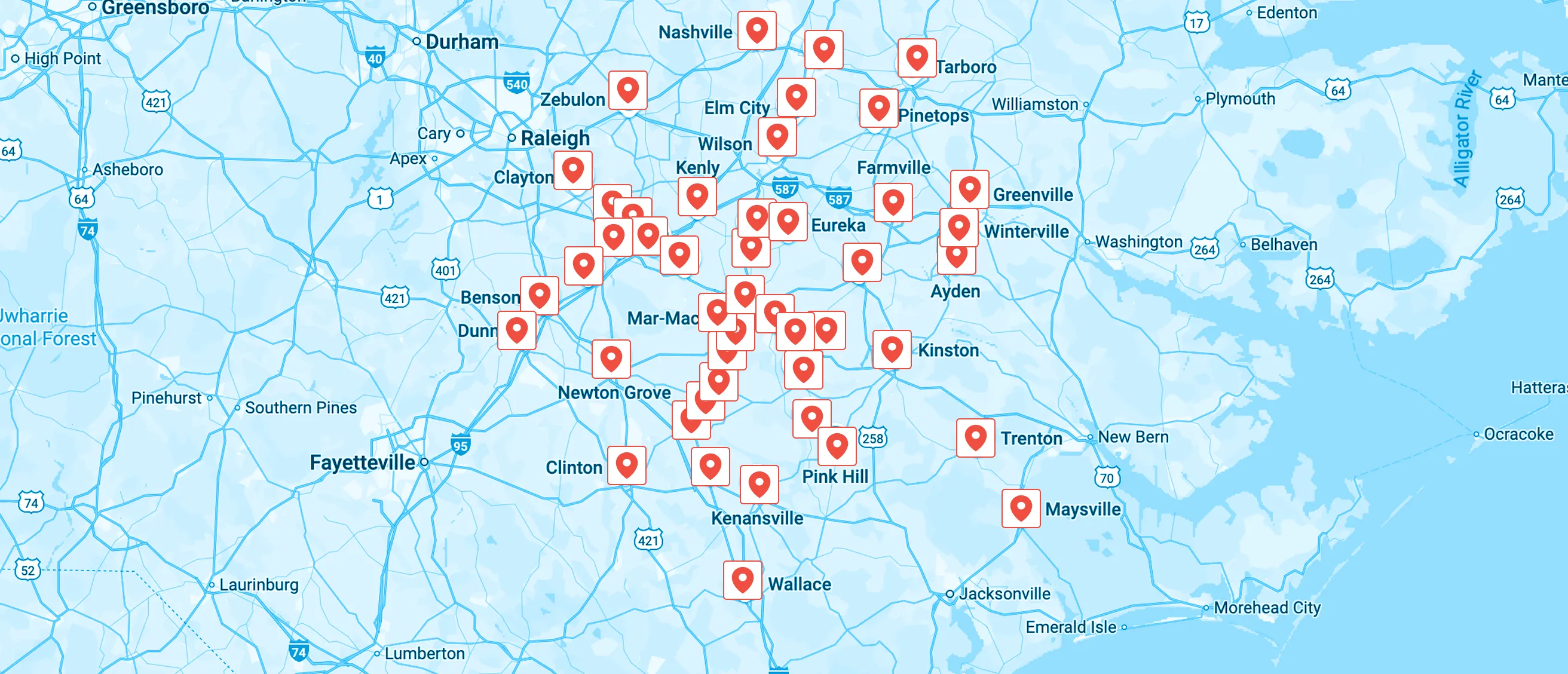
To prevent prolonged downtime, securing a professional AC inspection in Goldsboro is the most effective way to address these sudden control failures. Our team initiates a rapid triage process to determine if the issue is a localized control failure, a low-voltage wiring short, or a broader system malfunction. By systematically isolating the root cause, we ensure the right repair is executed without unnecessary delays for Goldsboro commercial rental properties.
• Commercial Tenants — Immediate Impact of Thermostat Failure: Uncomfortable working conditions, halted operations — Long-Term Consequence of Delayed Repair: Loss of daily revenue, employee dissatisfaction
• Property Managers — Immediate Impact of Thermostat Failure: Influx of urgent complaints, emergency coordination — Long-Term Consequence of Delayed Repair: Strained tenant relationships, potential lease disputes
• The HVAC System — Immediate Impact of Thermostat Failure: Potential short-cycling or safety lockouts — Long-Term Consequence of Delayed Repair: Premature wear on expensive commercial compressors
Initiating the 3-Hour Diagnostic Protocol for Commercial Tenants
Time is the absolute most critical factor when a commercial HVAC unit stops responding to thermostat commands. During peak July heat, indoor temperatures in commercial spaces rise rapidly, turning a comfortable office or retail storefront into an unbearable environment in less than an hour. In our years of keeping Goldsboro businesses cool, we've seen how the thermal mass of a building can only hold cool air for so long before the heat load overtakes the space, making rapid intervention essential for preventing business disruption.
Drawing on our extensive experience with local commercial cooling demands, our standard operating procedure guarantees a diagnostic arrival and initial assessment within a strict 3-hour window. This rapid emergency response time is a core operational standard for our commercial clients, ensuring that Goldsboro commercial properties receive the urgent attention required to keep their doors open. This rapid response protocol strictly prioritizes minimizing downtime for commercial tenants over all other variables.
When our team arrives on-site, they follow a highly structured triage protocol:
1. Immediate Dispatch and Arrival: Technicians arrive within the 3-hour window, fully equipped with commercial-grade diagnostic tools, multimeters, and replacement components common to commercial systems.
2. Tenant and Manager Consultation: We quickly gather data on when the screen went blank, whether any strange noises preceded the failure, and if other electrical anomalies occurred in the building.
3. Visual System Assessment: Before dismantling any equipment, we perform a rapid visual inspection of the thermostat interface, the indoor air handler, and the outdoor condenser to look for obvious signs of physical damage or tripped breakers.
4. Execution of the Diagnostic Sequence: Technicians immediately begin tracing electrical and mechanical faults, moving from the simplest potential failure points to the most complex, ensuring no time is wasted on guesswork.
Isolating the Issue: Thermostat Malfunction vs. Mechanical Failure
A blank thermostat screen does not automatically mean the physical thermostat device is broken. In fact, our team typically sees that a blank screen indicates a total loss of power originating from the main HVAC unit. Commercial thermostats do not typically run on standard wall batteries; they rely on a constant stream of low-voltage power supplied by the indoor air handler. If that power is interrupted, the screen goes dark, making it appear as though the control device has failed.
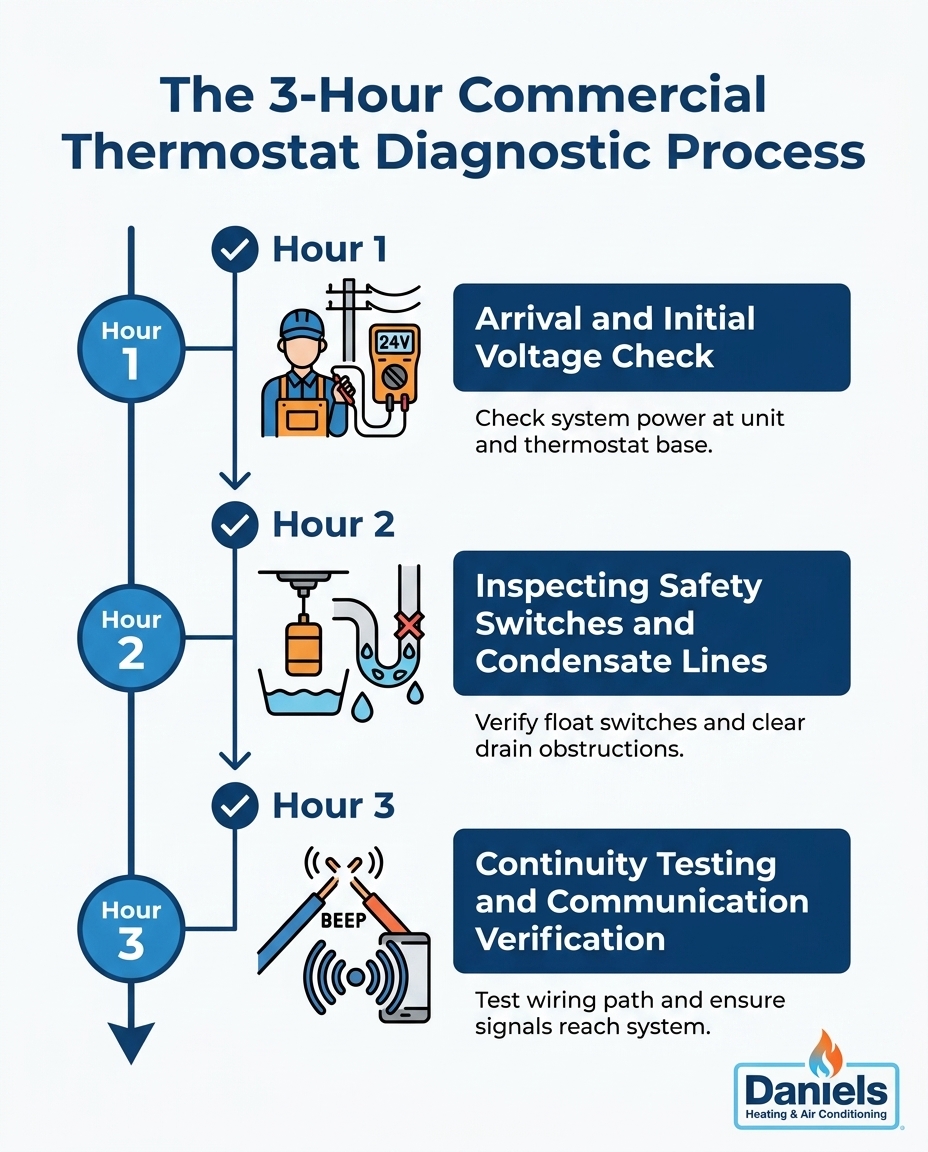
Our technicians first verify whether the thermostat is receiving its required operating voltage before ever recommending a replacement. We inspect the primary breaker panels and internal equipment fuses to rule out simple power surges, tripped building breakers, or blown automotive-style fuses on the control board. This methodical approach relies heavily on 24V low-voltage wiring and continuity checks to trace the exact location of the power loss.
This step prevents the costly and frustrating mistake of replacing a perfectly functional, expensive commercial thermostat when the actual issue lies deeper in the mechanical system. Property managers appreciate this precision, as it ensures capital is spent on actual solutions rather than unnecessary hardware swaps.
Checking the Power Supply at the Source
To pinpoint the power failure, technicians measure voltage directly at the air handler to confirm high-voltage power is successfully entering the system from the building's electrical panel. From there, we inspect the transformer. The transformer is a vital component responsible for stepping down the high line voltage (typically 120V or 240V) to the safe 24V control voltage required by the thermostat.
The quick fix vs. the real fix: If the transformer is outputting zero volts on the secondary side, the transformer has failed and must be replaced by a professional. If it is outputting 24V, but the thermostat is still blank, we know the power is being interrupted somewhere between the air handler and the wall-mounted control.
Why Summer Humidity Frequently Triggers Blank Thermostats
The Problem: During periods of extreme heat, commercial AC units run continuously, pulling massive amounts of moisture out of the indoor air. Goldsboro's peak summer humidity puts heavy condensate loads on these commercial systems, producing gallons of water every single day that must be safely drained away from the property.
The Cause: Over time, algae, dirt, and biological growth can accumulate inside the PVC drain lines. If a condensate drain line clogs, water backs up into the primary drain pan. To protect the commercial building from catastrophic water damage, ceilings leaks, and ruined inventory, a specialized mechanical safety float switch is installed in the pan. When the water level rises too high, this float switch trips, intentionally cutting the 24V power to the thermostat. This safety mechanism shuts down the entire AC system to stop the production of condensation.
The Solution: Because this is such a common occurrence in our local climate, our diagnostic process immediately checks these safety switches. Clearing a clogged drain line and resetting the float switch often restores thermostat function instantly, turning a suspected electrical failure into a straightforward plumbing clearance. Implementing a routine maintenance plan that includes regular drain line flushing can prevent these humidity-driven safety shutdowns entirely, keeping your 24V low-voltage wiring and continuity checks clear of water-related interruptions.
Executing 24V Low-Voltage Wiring and Continuity Checks
Commercial HVAC systems rely on a dedicated 24V control voltage circuit to communicate commands between the thermostat, the indoor air handler, and the outdoor compressor. When power leaves the transformer but fails to reach the thermostat, our team must track down the break in the line. Our technicians perform precise 24V low-voltage wiring and continuity checks along the entire wiring path to locate shorts, physical breaks, or severely degraded connections.
We meticulously inspect common failure points throughout the commercial facility. These include areas where low-voltage wires may rub against vibrating metal cabinets, eventually wearing through their insulation and causing a short, or areas in drop ceilings where rodents may have chewed through the communication cables. Complex commercial setups, especially those utilizing zoning systems and advanced air distribution, require methodical tracing to ensure every zone damper and sensor receives the correct electrical signals without interference.
Tracing the Control Circuit
Tracing a commercial control circuit requires professional-grade equipment and a deep understanding of HVAC wiring schematics. Our team executes this by:
• Testing the terminals: Using professional multimeters to test the common terminal block (R, Y, G, W, and C) for proper voltage levels.
• Identifying voltage drops: Looking for significant voltage drops across the circuit that indicate a failing transformer, a compromised wire, or a loose wire nut hidden in the ceiling.
• Isolating the short: Disconnecting wires one by one at the control board to see when a blown fuse stops popping, which isolates exactly which circuit (cooling, heating, or fan) contains the electrical short.
Verifying Communication Between Controls and the Air Handler
The final phase of our 3-hour diagnostic methodology ensures that the root cause has been definitively found and that full system restoration is possible. Once the power supply is verified, all safety switches are cleared, and the low-voltage wiring is confirmed intact, we test the communication relays to ensure the mechanical components still know how to take orders.
To prove whether the thermostat device itself is the culprit, our licensed technicians perform a bypass test. Because this involves live voltage and risks severe system damage, it is strictly a professional-level diagnostic that involves specific, highly controlled steps:
1. Disconnecting the interface: Technicians safely remove the thermostat faceplate and disconnect the control wires from the sub-base.
2. Bypassing the control: Using specialized jumper wires at the indoor control board, the technician manually connects the power terminal (R) to the cooling terminal (Y) and the fan terminal (G).
3. Observing the mechanical response: We monitor the air handler and the outdoor compressor to see if they engage properly and run smoothly without the thermostat in the loop.
4. Finalizing the diagnosis: If the commercial HVAC system runs perfectly when bypassed but fails to operate when connected back to the thermostat, the thermostat device itself is conclusively diagnosed as faulty and requires replacement.
This conclusive testing process is why our 24V low-voltage wiring and continuity checks are so highly trusted. It ensures that when we present a repair plan or a replacement quote to a property manager, it is one hundred percent accurate, eliminating the risk of return trips for the same issue.
Frequently Asked Questions About Commercial Thermostat Power Loss
How do professionals diagnose a blank commercial thermostat?
Professionals diagnose a blank commercial thermostat by systematically checking the power supply from the source. We start by verifying high voltage at the air handler, testing the transformer's 24V output, and checking for blown low-voltage fuses on the control board. If power is present at the board but not the thermostat, we trace the wiring for shorts or check inline safety switches that may have intentionally cut the power.
Why does a commercial AC thermostat lose power during summer?
A commercial AC thermostat frequently loses power during the summer because high humidity causes the system to produce excess condensation. If the condensate drain line clogs, water backs up into the drain pan and trips a safety float switch. This switch is designed to cut the 24V power to the thermostat, shutting off the AC to prevent the drain pan from overflowing and causing water damage to the building.
Why did my commercial thermostat suddenly go blank?
Your commercial thermostat likely went blank because it lost its 24V power supply from the main HVAC unit. This is rarely a failure of the thermostat screen itself; it is usually caused by a tripped breaker, a blown low-voltage fuse, a failed transformer, or an activated safety switch. A professional diagnostic is required to trace the exact point where the electrical circuit was interrupted.
How do you test a commercial thermostat?
Our licensed technicians test a commercial thermostat by verifying that it is receiving 24 volts of power across the R and C terminals using a multimeter. If power is present but the screen is blank or unresponsive, the device has failed. If the screen is on but the AC won't start, we bypass the thermostat at the main control board to see if the mechanical system engages, which proves whether the thermostat is failing to send the cooling signal.
What causes a thermostat to lose power?
A thermostat loses power when the electrical connection between the indoor air handler and the wall unit is broken. Common causes include a tripped main electrical breaker, a blown 3-amp or 5-amp fuse on the furnace control board, a burnt-out transformer, or damaged low-voltage wiring. Rodent damage to wires in drop ceilings is also a frequent culprit in commercial buildings.
Can a clogged AC drain line turn off my commercial thermostat?
Yes, a clogged AC drain line is one of the most common reasons a commercial thermostat turns off. Modern commercial HVAC systems are equipped with safety float switches in their drain pans. When the drain clogs and water rises, the float switch trips and breaks the electrical circuit to the thermostat, shutting down the entire system to prevent a costly indoor flood.
Fast Diagnostics Keep Your Commercial Tenants Comfortable
A structured, rapid-response diagnostic process is the absolute best defense against prolonged commercial tenant downtime. When a climate control failure threatens your business operations, guessing at the solution only wastes valuable time. By isolating control failures from mechanical issues quickly and accurately, we restore comfort, protect your property from water damage, and keep your tenants satisfied.
Our team is ready to deploy our proven 3-hour methodology for your facility. Whether you manage a retail storefront, a busy office complex, or a large industrial space, maintaining a reliable commercial HVAC system requires professional expertise. We have successfully applied this exact triage process to countless Goldsboro commercial rental properties, ensuring that minor electrical faults never turn into major operational disasters.
hear what our satisfied
clients have to say


Service areas